Tuesday, January 17, 2023

Goals, Algonquin, Watchlist & Canadian Compounders

My apologies for the jumbled format below, but in an effort to write at least one monthly entry, I’m choosing good-enough over perfection. 

Goals:

At the start of 2022, I set a goal to increase my forward dividend income by $4,600, while targeting
a dollar- weighted organic dividend growth rate of 5.0%. I’m proud to report that I overshot my goal, 

raising my forward dividend income by $5,300+, while achieving a 5.3% organic dividend growth rate.


I’m taking my foot off the gas a little in 2023, aiming to add $3,200 (now, a bit more than that
after Algonquin Power & Utilities cut their dividend in January 2023), to bring my expected total
dividend income to a milestone 
amount. I’d also like my dollar-weighted organic dividend growth
rate to exceed 5.0% again this year. If I can 
accomplish the $3,200 goal, I’d then focus on building
the compounding portion of my portfolio, and adding a 
broad ETF to my unregistered account.
For tax reasons, it no longer makes sense for me to grow forward dividend 
income so
aggressively while I’m still working.


Other Objective for 2023:

After reading Bill Perkins’ ‘Die With Zero’ last year, listening to some episodes of Ramit
Sethi’s ‘I Will Teach You to Be Rich’ podcast, and then consuming Morgan Housel’s ‘The
Art of Spending Money’ last week, I’ve been focusing 
on ways to convert money into
memories. I have difficulty spending money, often falling into analysis-paralysis, 
which
subsequently impacts my level of happiness. Choosing to spend on things my kids
might remember as they 
get older is a priority in 2023. A couple of quick examples
this month have been tickets for my son to see his first 
professional hockey game,
a Gatineau+ pass that has allowed me to bring my kids to an indoor skating rink over 

the holidays, and even grabbing lunch at a restaurant after spending the morning at
the Ottawa central experimental farm. Lastly, since the objective is about more than
making memories for my kids, I brought home 
some flowers for my wife, and after
using my pair of 30+ year old second-hand, cross-country skiis for the past 
three
years, I invested in a pair of brand new skis, that I’m planning to explore trails with
this year. 
Hoping that I can get better at converting money to memories over the
course of this year.


Algonquin Dividend Cut:

As mentioned above, and outlined on my ‘Investment Holdings’ tab, I have a position in Algonquin
Power & Utilities (TSX: AQN). With the 40% dividend cut, planned $1B of asset sales, and continued
pursuit of Kentucky 
Power, I’m not sure what my plans are with respect to the holding. My faith in
their management team is low, 
releasing another negative earnings estimate sure hasn’t helped, as
has the decision to continue to seek 
regulatory approval for their Kentucky Power acquisition.
Although, the latter simply might be mouth-service to 
avoid paying a walk-away fee if the
transaction doesn’t close by April (when they can walk away for a much lower 
payment).I’m
taking a wait and see approach in the short-term.


January 2023 Watchlist:

Texas Instruments Incorporated (NYSE: TXN) – Reading about how management has aggressively
retired shares, focused on operating profit and FCF generation, and thinks so thoroughly about
capital allocation has made me 
consider initiating a position in this stock. Of course, since I started
to track it, the stock has risen over 5%.


Brookfield Infrastructure Partners (TSX: BIP.UN) – Of all the Brookfield units, I like BIP’s mix of assets,
geographical diversification, and results the best. Although this is already one of my larger portfolio
positions, I’m still very 
comfortable adding more to it inside my TFSA. As potential buys usually do,
BIP has steadily risen through 
January 2023.


A&W Revenue Royalties (TSX: AW.UN) – With this being the only Canadian stock left in my RRSP, my
thoughts areto add to my position in A&W in my TFSA, and then wait a month to sell my position in
my RRSP. This would free 
up funds to invest in a U.S. stock in my RRSP (possibly Texas Instruments).


Waste Connections Inc (TSX: WCN) – An environmental company I’m considering adding to the
“compounder” portion of my portfolio.


Canadian Compounders

One of my aims for this blog is to always provide readers with something helpful. If you’ve come this far,
I thought you might enjoy this tweet from @long_equity with a list of the Canadian companies with the
most linear share 
price growth over the last 10 years.


Friday, December 30, 2022

7 Canadian Companies Providing Dividend Growth Guidance heading into 2023

In 201720192020, and 2021, I shared a list of Canadian companies that provide dividend growth guidance. I've decided to update this list as I find dividend growth guidance, specifically when it is expressed as a percentage, useful in helping me assess the capital allocation plans for companies, introducing a soft control by which to judge management's actions, and assisting me in projecting the organic dividend growth rate of my portfolio for 2023. 

The table below could be considered a starting point for further research. Please, let me know of any other Canadian companies that provide dividend growth guidance. I'll gladly update the table with your input. 

TC Energy Corp (TRP - 7.4%)                     
Dividend growth of 3-5% 
Emera Inc (EMA - 3.9%)
Dividend growth of 4-5% per year through 2025
Telus Corp (T - 5.2%)
Dividend growth of 7-10% per year through 2025
Capital Power Corp (CPX 6.8%)
Dividend growth of 6% per year through 2025
Fortis Inc (FTS - 5.9%)
Dividend growth of 4% - 6% per year to 2027
Brookfield Renewable Partners (BEP.UN - 5.0%)
Annual distribution increases of 5-9%
Brookfield Infrastructure Partners (BIP.UN - 5.2%)
Annual distribution increases of 5-9%


In what was a tough year for the Canadian stock market, it is promising to note that none of the seven companies that provided dividend growth guidance in 2021 stopped doing so in 2022. I'm also cautiously optimistic that Brookfield's "BAM" units might start issuing distribution guidance sometime in 2023. Lastly, it's worth noting that perhaps Algonquin Power & Utilities Corp's move away from providing percentage based dividend growth guidance in 2021, could have been a red flag in retrospect. 

Here's wishing everyone a healthy and prosperous 2023!

Friday, October 7, 2022

The Bank of Nova Scotia - Thoughts

Although I try not to spend too much time hanging out on Twitter, @thedividendguy had an interesting question last week about why people buy the Bank of Nova Scotia ("BNS") over other Canadian banks. The question was worthwhile given BNS has underperformed its peers over the past five years, and is down about 20% over that period if you don't include dividends received. Reading through the answers of others, and then writing my own, made me wonder if BNS was worth owning at all. Without diving too deep into numbers, I thought it would be worthwhile to think about some of the top reasons BNS is worth investing in, and the key risks it currently faces.

Reasons
1. Total return potential: As of the time I'm writing this, BNS has a dividend yield just north of 6%, and it looks pretty safe given it only represents about 50% of net earnings. Not only is BNS priced relatively low compared to its Canadian banking peers (current P/E is ~8%), its multiple is below its own historical average of ~10% - 11%. Assuming BNS makes it through what feels to the inevitable recession in Canada, you'd be looking at a 9-10% return if the bank can get back to its own historical multiple. 

2. New CEO incoming: Although I don't profess to know very much about incoming CEO Scott Thomson, I wonder if Brian Porter "retiring" isn't a chance for the bank to move past some of their past missteps taken under Porter's leadership. It seems fair to say that Porter's bets in Latin America have at best underperformed, and the bank exiting all but four markets in the region (Peru, Chile, Mexico and Colombia) appears to be a first step in admitting a mistake. Call me crazy, but I think Mr. Thomson is more likely to consider exiting one or more of those remaining markets, and blaming the miscue on his predecessor. 

3. Canadian results remain strong: Although BNS reports on four segments, their Canadian banking segment results accounted for almost half their net profits through Q322, growing 23% year-over-year. As stated above, I do think Canada will inevitably go though a recession in the next year, but BNS has the capital base and experience to make it through to the other side. Between their expansive branch network, ability to cross-sell through various subsidiaries and platforms (Tangerine, Scotia Itrade, etc.), and their credit card business, it's hard to avoid dealing with the bank.

Risks
1. Reliance on Canada for profit generation: In fairness to BNS, I think this is a material risk for all Canadian banks, and Scotia might be the least exposed to the Canadian economy of any of the big six banks. That said, a long recession in Canada, a severe correction in home prices, or a series of large corporate defaults would greatly impact BNS's results.

2. New CEO could be ineffective: Based on a recent article in the Globe that explored how Mr. Thomson went from running the Board of Directors committee responsible for hiring a new CEO, to being named the new CEO of BNS, in a manner of months, I'm unsure if he represents an upgrade from Mr. Porter. Although he has some banking experience with Goldman Sachs in his distant past, it's rare for Canadian banks to hire relative outsiders as CEOs. Apparently, his former company also struggled with some issues in the South American countries it operated in. Lastly, as a Board member at BNS, I would think he would have shared any ideas to improve the bank's results with Mr. Porter, instead of saving them in case he eventually took over the bank.

3. Regulatory / ESG Risks: From December 2020, to November 2021, the Office of the Superintendent of Financial Institutions, that regulates banks in Canada, halted banks from increasing their dividends in order to conserve capital. After his Liberals won the last federal election, Prime Minister Justin Trudeau announced that banks (and insurance companies) would see a 3% increase in the tax rate they pay on their profits in excess of $1B. When considering how ESG concerns have made banks decrease financing of environmentally unfriendly industries is added to the two examples of regulatory risk outlined above, I become concerned that BNS will have a difficult time managing new rules/regulations/standards imposed on them. 


Although on balance I think the reasons one might invest in BNS slightly outweigh the apparent risks, the risk/reward relationship is far from optimal, with little margin of safety. For this reason, although I don't intend to sell my position at this time, I'm not confident enough to add to it either.


Sunday, September 18, 2022

Less Dividends, More Growth Experiment

As I've touched on in my Transactions Journal this year, I'm experimenting with owning some companies that are less inclined to pay dividends, and more focused on pursuing growth strategies. This is clearly a departure from my usual dividend growth holdings, and I wanted to provide context around my thinking behind the experiment.

One of primary reasons for undertaking the experiment is that my current Investment Holdings are doing a great job of generating rising income through dividend/distribution growth. The big downside of that growing income is that by living in a province with one of the higher marginal tax rates in Canada, during a stage in my professional career when my earnings have exceeded my expectations, my dividend income gets taxed quite aggressively. Simply put, if I can identify companies that reinvest their profits, instead of paying them out to shareholders, it is in my short-term and long-term best economic interests.

Another reason for pursuing growth oriented companies is to help switch my focus from income to total return. Although conceptually I know total return is more important to pursue than a rising income stream, my actions haven't reflected that knowledge. It's probable that by being motivated by "financial freedom" and avoiding scarcity, I have ventured much too far into the income oriented mindset. As I nudge closer to the next phase of my life, focusing on total return and adopting an abundance mindset will help me enjoy my time.

Lastly, I feel that by looking for companies that don't pay part of their earnings out to shareholders will help keep me mentally sharp. As I've bought and added to my positions in the same 25-or-so Canadian companies over the past decade, I missed opportunities to invest for total return. I've noticed in slowly building my experimental portfolio that there are compelling growth stories in Canada, that are worth devoting some time and effort. I'm reminded of a quote in a recent podcast featuring Tren Griffin, during which he talked about "choosing the paths in life that lead to the best stories".  His strategy of optimizing for memories really hit home with me.

So what types of companies am I experimenting with investing in? A couple characteristics are important:
- Above-average revenue growth
- Strong profit margins
- Runway for further above-average growth
- Consolidators are especially interesting
- Managed by good capital allocators

At this point, I've taken the plunge into three companies that match most of the criteria above:
- goeasy Ltd (TSX: GSY)
- Constellation Software (TSX: CSU)
- Dye & Durham Limited (TSX: DND)

Although the above names have all fallen since I initiated my small positions (pretty common for anything I invest in), I choose to reframe the lower prices positively as it speaks well for the potential return prospects in the future if the companies stick to their strategies, show good results, and price multiples return to their pre-2022 averages. In the meantime, I'm thinking about adding another position or two by year end, possibly one related to the environment and/or healthcare. Looking forward to seeing how this experiment turns out!


Sunday, February 27, 2022

Two Stock Portfolio - ETF Experiment Continued

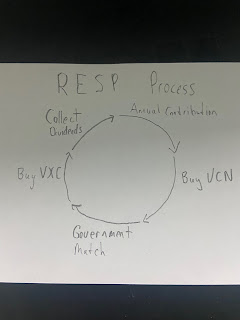
In May 2016, I posted about my ETF experiment involving buying VCN (Vanguard FTSE Canada All Cap Index ETF) and VXC (Vanguard FTSE Global All Cap ex Canada Index ETF) for my son's Registered Education Savings Program ("RESP"). Although this was a clear departure from my normal dividend growth investing strategy, the main reason that I pursued the strategy was simplicity. Having added my daughter to the RESP after she was born in July 2017, the two stock portfolio continues to be straight-forward, as shown in the below diagram. 

On a yearly basis, I spend about fifteen minutes on the strategy. The first five minutes relates to re-learning what is a needlessly complicated bill payment I have to use to make the annual contribution through Scotia itrade. A day or two later, after the contribution "magically" appears in the RESP account (sadly, I'm not making that up), I spend another five minutes calculating how much VCN to buy in order to keep the position sizes relatively equal, accounting for future government matches (both federal and to a lesser extent provincial) and upcoming dividends that will be added to the account. The last five minutes are split between buying VCN, and then waiting to see that both government matches hit the account before buying VXC.

Some of the advantages of this two stock RESP include:

- Very simple: Compared to the amount of time I spend on my normal portfolio, 15 minutes a year is awesome!
- Good country diversification: With half the portfolio allocated the Canada, VXC provides me exposure to the U.S., Japan, China, France, Switzerland, Germany, etc. at a very reasonable 0.27% management expense ratio. 
- Minimal cost: Beside VXC's 0.27% management expense ratio, VCN has a management expense ratio of only 6 basis points, and the two buys a year cost me a total of $20 in commissions. 
- Can do it all online: It's only been in the last three years that Scotia itrade hasn't required I send in a physical cheque to fund the annual contribution. 

On the flip side, there are disadvantages to the two stock RESP as well:

- Owning companies you'd rather not: With market capitalization being a dominant factor, there are a handful of companies in VXC I'd rather not own (i.e. Tesla, Facebook, etc.).
- VXC's holdings are not reflective of global market capitalization: VXC is heavily tilted toward the U.S. (60.5% of the ETF's holdings), and ignores some large international companies that are publicly traded (i.e. Saudi Aramco). 
- Scotia itrade's shortcomings: Charging $10 for buying an ETF, seeing your annual contribution disappear for a couple days, waiting an extra day or more to pay out dividends...all the frustrating parts of being a client of itrade continue to impact this RESP strategy.


The longer the two stock RESP experiment runs, the more I continue to love the simplicity of the strategy. I fully plan to stick to the strategy until my daughter turns 16, at which time the federal and provincial governments will no longer partly match the contribution. The only change I envision is potentially moving away from Scotia itrade given the shortcomings outlined above.