Wednesday, December 22, 2021

7 Canadian Companies Providing Dividend Growth Guidance

In 20172019, and last year, I shared a list of Canadian companies that provide dividend growth guidance. I've decided to update this list as I find dividend growth guidance, specifically when it is expressed as a percentage, useful in helping me assess the capital allocation plans for companies, introducing a soft control by which to judge management's actions, and assisting me in projecting the organic dividend growth rate of my portfolio for 2022. 

The table below could be considered a starting point for further research. Please, let me know of any other Canadian companies that provide dividend growth guidance. I'll gladly update the table with your input. Lastly, the percentage beside the company's ticker symbol in brackets is the amount of the 2021 dividend increase.

TC Energy Corp (TRP - 7.4%)                     
Dividend growth of 3-5% (down from 5-7% previously)
Emera Inc (EMA - 3.9%)
Dividend growth of 4-5% per year through 2024
Telus Corp (T - 5.2%)
Dividend growth of 7-10% per year through 2022
Capital Power Corp (CPX 6.8%)
Dividend growth of 5% per year through 2025
Fortis Inc (FTS - 5.9%)
Dividend growth of 6% per year through 2025
Brookfield Renewable Partners (BEP.UN - 5.0%)
Annual distribution increases of 5-9%
Brookfield Infrastructure Partners (BIP.UN - 5.2%)
Annual distribution increases of 5-9%


For those of you with a sharp eye, you may notice two companies missing from last year's list. Enbridge and Algonquin Power & Utilities Corp. Sadly, both companies moved away from providing percentage-based dividend growth guidance in their recent investor day presentations. Enbridge indicated that over the next three years, their dividend growth will be "up to level of medium-term DCF (distributable cash flow) / share growth". On the same slide of the presentation, the company indicates that they expect DCF growth per share to be in 5 to 7% range over the same time period. I chose to drop them from the above table as including the qualifier "up to" and knowing the company makes some subjective judgements in calculating their DCF each quarter. Similarly, Algonquin moved away from providing the crystal clear 10% dividend growth guidance, to indicating that their dividend growth will be based on "Sustainable long-term payout ratio target of 80-90% of normalized earnings". It is worth noting that the company expects their adjusted EPS growth from 2022 - 2026 to be between 7-9%. Again, given the company can wiggle anywhere within a 10% band of "normalized earnings" (another non-GAAP term), I don't feel comfortable including them in the above table.

As more companies start to move away from providing clear, percentage based dividend growth guidance, I may have to draft another entry to cover some companies who refer to a special ratio, or another less structured way to provide guidance on their distribution growth. It's definitely sad to see Algonquin and Enbridge move away from providing simple dividend growth guidance. 

Sunday, December 12, 2021

Never Selling a Stock

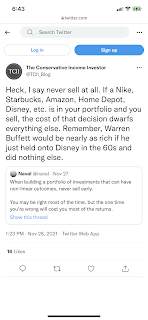
Despite having my annual 'Canadian Companies that Provide Dividend Growth Guidance' post almost complete, I decided to switch course and post about a tweet that has been caught in my mind for the past two weeks.

Before explaining the benefits and drawbacks of never selling a stock holding, I can't recommend highly enough following The Conservative Income Investor's blog, twitter and Seeking Alpha page. I'd go as far as to guess that subscribing to Tim's Patreon would likely pay literal and figurative dividends. 

The most obvious benefit of never selling a stock is nicely summed up in Tim's tweet: the lost return on a potential winner could not only be devastating for your portfolio's prospects, it could be an error of commission for which you never forgive yourself. Having sold a position in Home Depot in 2012 for $63 (representing an ~150% gain after five years of holding the company), it's been heart-breaking to see it march up to the current price of $415. Had I not sold, Home Depot would represent my largest position, and would have been a steady gainer and dividend grower over the past nine years. Sadly, I've sold many other companies that went on to produce huge gains for more patient investors than me. 

A couple other benefits that come to mind if one chooses not to sell any holdings are the time savings from not worry about when to sell, no taxes would be due if investments are held outside of registered accounts, no transaction costs from selling, and having a more diversified portfolio assuming you continue to buy shares in other companies.

The biggest drawback I think to following Tim's advice is that your portfolio holdings would balloon to a number that would make it difficult, if not impossible, to monitor your various investments. Having cut my number of holdings down from 40 to 37 in the past year, I still hold too many positions to monitor each effectively. The other material downside I see to never selling is continuing to hold companies that changed their strategic direction to something you don't support or have an opinion on. As an example, if I continue to hold the shares of Orion Office REIT that were spun off after the VREIT and Realty Income merger, I'd be making a bet on the recovery of the commercial office space market in the United States, something I feel particularly ill-equipped to do. 

Other drawbacks in never selling shares is companies you hold include not being able to take advantage of tax loss harvesting (assuming positions are held in unregistered accounts), having position sizes that don't reflect your current convictions, and potentially lacking liquidity to take advantage of market displacements. 

Although I haven't come to any conclusions as to whether I'll start following the "never sell" advice from the Conservative Income Investor's tweet, it's something I'll continue given the pain and lost return of selling a big winner is difficult to overcome.

Friday, November 26, 2021

My Three Smallest Stock Holdings

After my last entry explored my three largest holdings, I thought it would be fun to write about my three smallest positions. Do these companies represent my lowest convictions? Am I uncomfortable with holding these companies? Why do I keep these positions in my portfolio? These are questions I think the below descriptions will help answer.

Smallest position: Orion Office REIT Inc. (using USD / CAD exchange rate of 1.28)

A couple days after Realty Income completed their acquisition of VEREIT earlier this month, Orion Office REIT was spun-out and the shares appeared in my account in a ratio of one for every 10 Realty Income shares I own. Based on the preliminary financials, this looks like a stable office REIT.  Since I received the shares, they’re down about 20% as other Realty Income holders see a small number of shares in this pure-play office REIT appear in their accounts and subsequently get rid of them. My instinct was to sell them as soon as I received them, but I held back thinking I’d wait to see where the shares settle price-wise. That was probably a poor decision, but without any big plans to invest in US stocks at the moment, I can afford to take some time to see how Orion does in the short-term.


Second smallest position: Omega Healthcare Investors, Inc.

Omega has a couple factors contributing to being my second smallest position. The fact the share price is down over 30% since reaching it’s 52-week high earlier this year is a material contributor. Omega has at least one operator of their assisted living and nursing facilities in bankruptcy proceedings at the moment. I haven’t added to my position since 2015, given my lack of conviction that the company can return to the type of distribution growth they did in their best days, boosting distributions by a penny each quarter. Instead, distributions have been flat for over two years now, despite the company still bragging about their streak of distribution growth. I’ll admit that I have considered selling this REIT multiple times, but it is hard to replace their current 9% yield, that is covered by FFO even during difficult times due to covid-19 and rent collection challenges from operators. I could still see myself getting rid of this in the next couple months, if an opportunity to reinvest the capital with better growth prospects presented itself.


Third smallest position: The Coca-Cola Company

For context, my level of comfort holding onto my shares in Coca-Cola is much, much greater than Omega. Their sales have bounced back nicely from coronavirus linked lows, to around the level they were back in 2019. That said, their elevated EPS payout ratio is a bit scary (102% currently), as is the fact that shares are selling for 26X earnings. Although I haven’t added to my position since initiating it in 2014, I have thought about adding lately. Yes, their dividend growth is barely tracking inflation, but the performance of their shares over the last two years has been resilient. Given this might be a nice play on finally getting over the covid-19 pandemic throughout the world, I could imagine adding a small amount to this position in the short-term so that it would be approximately equal to my next smallest position, the Canadian Imperial Bank of Commerce.


In summary, it wouldn’t shock me to sell either Orion or Omega before year end, as opposed to Coca-Cola where I’d consider adding. It was interesting for me that all my smallest positions are US companies, but maybe shouldn’t have been given limited funds each year to invest in my RRSP.

Friday, November 12, 2021

My Three Largest Stock Holdings

 When looking at the position sizes of your portfolio holdings, do your largest positions represent your highest convictions? Philosophically, at least for me, I think this should be the case. At the very least, my largest holdings should be companies I’m very comfortable holding through good times and bad. In that spirit, I thought I’d take a peek at my three largest positions, to ensure my capital was well allocated.


Largest position: Microsoft (using USD / CAD exchange rate of 1.25)

Despite initiating a position in Microsoft in October of 2013, and not adding to it since, it has grown to be my largest holding. Considering the company’s top and bottom line growth, perfect ‘AAA’ credit rating, and the fact they currently have the largest market capitalization of any North American company, I feel secure holding onto my shares. The explosive stock price gain in recent years means dividend yield is currently a paltry 0.7%, but on the flip side, the company continues to boost dividend payouts annually at a rate far greater than inflation. Lately, I’ve even considered adding a small number of shares to this flower that seems poised to continue to grow to the sun.


Second largest position: A&W Revenue Royalties Income Fund

As easy as it has been to hold Microsoft over the past couple years as the company’s share price kept rising, A&W experienced a rockier road. When the pandemic started in March 2020, A&W’s share price plunged to under $18, down from about $39. When public health measures entailed shutting down restaurants and cutting indoor dining, the company was forced to cut their monthly distribution from 15.9 cents, to 10 cents. However, due to the return to in person dining at many restaurants, more locations being added to the royalty pool, and higher same store sales, the company has steadily increased their distribution back to an impressive 15.5 cents per month. The company’s share price has also rebounded from the ~$18 lows to over $41 today. After not only holding my shares during the difficult period for A&W, but adding to them, I might look to expand my holdings in this company if pandemic restrictions continue to loosen in Canada.


Third largest Holding: Telus Corporation

My comfort at holding Telus is probably best demonstrated by my buying shares in the company in 2013 (twice), 2014 (twice), 2015 (twice), 2020 and 2021. Simply, Telus’s management team has been clear and consistent about their intentions to reward shareholders with semi-annual dividend raises in the 7% -10% range. These increases in payouts are supported by generating growing revenue and free cash flows. Although some might argue Bell or Rogers would be better situated for future growth given Telus’ focus on western Canada, I think the fact that Telus has the best rated customer service of the big three Canadian telecommunications companies bodes well for their growth prospects over the long-term. Although I’m not planning to add to my position anytime soon, and would likely add to my relatively smaller position in Bell instead, I’m perfectly comfortable with Telus being my third largest holding.


My next largest positions in my portfolio are Granite REIT and Brookfield Infrastructure Partners, both of which I’m considering adding to before year end. In summary, I’m comfortable with my largest three holdings, and hope all my readers feel the same way about their most valuable positions. 

Tuesday, August 3, 2021

My No-Longer Unwritten Rules

Since I haven’t been posting much over the last couple years, but I’ve kept consistently adding to my portfolio, I thought it was time to formalize the unwritten rules I’ve been following.

-          Make at least one purchase every month: The rationale is that if I get in the habit of regularly adding to my portfolio, I’ll be less likely to hoard money in an attempt to time the market.

-          Only add to positions that have grown their dividend in the past 12-months: Although there are companies in my portfolio who have not grown their distributions in the past year, I simply won’t add to them as I’d rather focus on exceptional companies that are able to grow their distributions regularly over time.

-          Do not add to any position if the result is the holding accounting for more than 5% of my total portfolio value: Although I’m not against holding concentrated positions, I’d prefer that they develop organically via share price growth, as opposed to through my overconfidence.

-          Sell losers, not winners: The analogy of harvesting flowers and watering weeds is pertinent for me, especially in my unregistered account, where tax loss harvesting is an excellent strategy to minimize my long-term taxable capital gains. Plus, I’m almost always wrong when I think “This stock can’t possibly go any higher…it’s already so overvalued!”

-          Never compare myself to anyone else: I used to track my progress against some of you who are reading this, but the reality is that we likely have very different goals, personal circumstances, and investing philosophies. Although I'm always happy to see a peer who is making progress in their journey, I find my joy focusing on my own process of investing. 


That's all for now. I hope to keep updating this post as I find more rules that I'm following.