Tuesday, January 9, 2024

Atomic Habits - 3 Takeways

I'm the proud owner of one of 15 million copies of Atomic Habits by James Clear that has been sold since being published in 2018. I re-read the book in an effort to get 2024 off to a good start, and wanted to share three quick takeaways:

Four Laws of Habits
To increase the adoption of good habits, you can make them obvious, attractive, easy and satisfying. In contrast, to decrease bad habits, make them invisible, unattractive, difficult and unsatisfying. After re-reading, I got the idea of "habit stacking" (adding a new habit after an existing one) to start adding teeth brushing to my habit of flossing and using mouth wash while bathing my kids. This has allowed me to stop snacking after supper, as even the most delicious snack tastes less appealing post-brushing.

Don't Let Habits Become Too Much of Your Identity
My simple brain has tried to classify myself according to past habits that grew too large (ultimate frisbee, running, reading, dividend growth investing, etc.). James Clear makes the case for keeping our identify fluid, and not letting any one habit become too much of a part of ourselves. In that spirit, I thought I'd write about this book I love in my dividend blog. 

Aim for a Majority, Not a Sweep
Like everyone, I have bad habits I'm trying to vanish. James Clear uses the metaphor early in the book that every time you perform a good habit, or skip a bad one, you could see it as a vote for the type of person you want to become. He goes onto explain that instead of aiming for perfection, we should be happy with a majority, cause it's impossible to earn everyone's vote in an election. This is a lovely metaphor that I posted on my laptop so that I take it easier on myself going forward.

Since you've read this far, the last tidbit I'm being contemplating lately is how to make more desirable habits into a two minute version. Knowing that doing something easy is better than doing nothing, and taking a step in the right direction will cause some momentum, I'm aiming to try two minute versions of various habits this year.


Monday, January 1, 2024

Goals and Books

Happy new year! Here's hoping your 2024 is off to a great start. After barely posting the last couple of years, I decided to not renew the dividendsinhand domain and go forward with blogger instead.  

Goals:
I'm glad to report that I achieved my 2023 goal of adding $3,200 of dividend income, even if I fell a little short of my 5.0% target for organic dividend growth (4.63% at year end).

For 2024, I'm going to target the same $3,200 increase in forward dividend income and make an effort to achieve a 5% organic dividend growth rate. Complicating factor is I only plan to invest about a third of my contributions + dividends + starting cash balance into dividend growers in 2024. The other thirds will be placed in a Canadian index fund and "compounders" (think Constellation Software, in which I've slowly grown a nice position).  Reasoning is to keep taxes down.

Additionally, I'll continue to look to spend my money on things that create memories for my kids and wife. Likely some trips, hockey games, concerts, and similar experiences. I got better at doing this over the past 12 months, and I'm committed to upping my game in 2024. Also looking to keep investing in my health (dumbbells, running shoes, ski pass, tournament fees for volleyball and ultimate, etc). 


Books:
A friend and I track our reading via a Google sheet and I was surprised to reach 82 books in 2023. In case you're a fellow reader, listed below are the books I read, along with my rating out of 5. 

Run Rose Run - Dolly Parton & James Patterson (3.5)
Hello World - Hannah Fry (3.5)
The Other Emily - Dean Koontz (3.5)
Beyond the Wand - Tom Felton (4)
Beartown - Fredrick Backman (4)
Get it Done - Ayelet Fishbach (3.5)
Sparring Partners - John Grisham (4)
Desert Star - Michael Connelly (3.5)
Forever Terry - Various (3.5)
Klara and the Sun - Kazuo Ishiguro (3.5)
Mindset - Carol Dweck (3.5)
My Squirrel Days - Ellie Kemper (3.5)
Us Against You - Fredrick Backman (4)
The Shallows - Nicolas Carr (3.5)
The Intelligent Quality Investor - Long Equity (3.5)
Long Shadows - David Baldacci (3.5)
Hello Molly! - Molly Shannon (3.5)
The Bond King - Mary Childs (3.5)
The Creative Act - Rick Rubin (4)
The Winners - Fredrik Backman (4)
Tomorrow and Tomorrow and Tommorrow - Gabrielle Zevin (4.5)
The Acquirer's Multiple - Tobias Carlisle (3.5)
The Boys from Biloxi - John Grisham (3.5)
Hench - Natalie Walschots (3.5)
Friday Night Lights - H.G. Bissinger (3.5)
The 12 Hour Walk - Colin O'Brady (3.5)
The Game - Ken Dryden (4)
The Legend of Bagger Vance - Steven Pressfield (4)
This is What it Sounds Like - Susan Rodgers (3.5)
Good for a Girl - Lauren Fleshman (4)
Anxious People - Fredrik Backman (4)
When the Game Was Ours - Jackie MacMullan (4)
Billy No-Mates - Max Dickins (3.5)
The Adventures of Amina al-Sirafi - Shannon Chakraborty (3.5)
Friends, Lovers, and the Big Terrible Thing - Matthew Perry (3.5)
Building a Second Brain - Tiago Forte (4)
The Storied Life of A.J. Firkry - Gabrielle Zevin (4)
Less - Andrew Greer (3.5)
The Terraformers - Annalee Newitz (3.5)
Chaos Kings - Scott Patterson (3.5)
The House Next Door - James Patterson (3.5)
Elsewhere - Gabrielle Zevin (3.5)
Fundamentals of Corporate Credit Analysis - Blaise Gauguin (3)
The Greatest Salesman in the World - OG Mandino (3.5)
The Art of Learning - Josh Waitzkin (3.5)
Young Jane Young - Gabrielle Zevin (4)
When McKinsey Comes to Town - Walt Bogdanich (3.5)
How to Host a Viking Funderal - Kyle Scheele (4)
Dark Angel - John Sandford (4)
The Longest Race - Kara Goucher (3.5)
The Wild Things - Dave Eggers (3.5)
All These Things I've Done - Gabrielle Zevin (3.5)
The Nineties - Chuck Klosterman (3.5)
The Road - Cormac McCarthy (4)
Elon Musk - Ashlee Vance (3.5)
Fundamentals of Corporate Credit Analysis - Arnold Ziegel (3)
Michael Jordan The Life - Roland Lazenby (4)
Carrie Soto is Back - Taylor Jenkins Reid (4)
Camp Zero - Michelle Min Sterling (4)
Both Flesh and Not - David Foster Wallace (3.5)
From Strength to Strength - Arthur Brooks (4.5)
SuperBetter - Jane McGonigal (3.5)
Discipline is Destiny - Ryan Holiday (4)
Raffi: The life of a children's troubadour - Raffi (3.5)
The City of Brass - S.A. Chakraborty (3.5)
Surely You're Joking Mr. Feynman - Richard Feynman (4)
Going Infinite - Michael Lewis (4)
Clear Thinking - Shane Parrish (4)
L'Ickabog - JK Rowling (4) in French
The Sparrow - Mary Russel (4)
Murakami T: T-Shirts I Love - Haruki Murakami (4)
Hidden Potential - Adam Grant (4)
Norwegian Wood - Huruki Murakami (4)
Of Boys and Men - Richard Reeves (3.5)
Colorless Tsukuru Tazaki - Haruki Murakami (4)
The Secret - Lee Child (4)
Same as Ever - Morgan Housel (4)
Writing for Busy Readers - Todd Rogers (4)
Wind / Pinball - Haruki Murakami (3.5)
Things My Son Needs to Know About the World - Fredrik Backman (4)
The Real Work - Adam Gopnik (4)
Dead in the Water - Kit Chellel (4)


Wednesday, June 7, 2023

Beyond PADI

Every November when it comes time to renew the domain name for this blog, I promise myself that I'll write more in the new year. My best intentions usually lose steam in late January or early February. In order to recreate the spark, here is the fourth of what could best be described as 15 30-minute, quantity over quality, blog entries. 

Recently at work, a colleague and I conducted the second round of interviews for credit analysts, talking to six candidates. The last question we asked each candidate was “What do you feel is the best ratio to determine the credit worthiness of a company?” The question got me thinking about what the most important ratio would be to assess the health of an investment portfolio.

In the dividend growth investing space, based on what I see on blogs and Twitter, projected annual dividend income (“PADI”) seems to be the most popular ratio. Having used the PADI ratio as one of three metrics I calculate to assess my portfolio, I can see the draw. The number is precise, pretty easy to calculate, and its growth over time gives the impression that your portfolio is on the right track. That said, PADI can also mask the fact that you might be reaching for yield, or that you are simply adding lots of dollars to your investments. Importantly, PADI also assumes that dividend cuts don’t happen, which has not been my experience in the near 20 years I have invested in stocks.


The two other metrics that I use to assess the performance of my portfolio are dollar-weighted, organic dividend growth rate and portfolio IRR. The organic dividend growth rate keeps me honest in terms of limiting the number of times I reach for higher yielding stocks, while the IRR incorporates any inflows/outflows to/from my portfolio. Of these two ratios, the organic dividend growth rate is easier to manipulate, as I could choose to invest only in companies that grow their dividends at a rapid rate, or sell any company that cuts their dividend before the next time I calculate the ratio.

 
In case you’re wondering, there was no “right answer” to the interview question, we simply wanted the candidates to justify their responses. The answers were varied, but the depth of understanding the candidates showed by elaborating on their responses allowed us to differentiate the applicants. Similarly, I don’t feel that PADI is the perfect measure to assess portfolio health, given the wealth of other options available (without having even mentioned portfolio yield, various value metrics, FCF yield, etc.), so long as you’re able to explain why you choose other ratios to calculate. Like most aspects of investing, the metrics you choose to use should be relevant for you, and help you achieve your long-term goals.

Sunday, April 2, 2023

Dividend Growth Watch List for April - June 2023

Every November when it comes time to renew the domain name for this blog, I promise myself that I'll write more in the new year. My best intentions usually lose steam in late January or early February. In order to recreate the spark, here is the third of what could best be described as 15 30-minute, quantity over quality, blog entries. 

     With dividends flowing in regularly, on top of my regular monthly contributions to my investment accounts, and a decent amount of cash in my TFSA and unregistered accounts at the end of the first quarter, here are some of the companies I'm considering buying shares in heading into the second quarter of 2023.

     The most likely purchase in my TFSA is to increase my position size in Brookfield Infrastructure Partners L.P. (TSX: BIP.UN). BIP has grown to be one of my top five largest holdings, as I like the fact it gives a good amount of geographic and sector diversification, I feel it has strong management, and leverages the well-known "Brookfield" name to get access to acquisitions that other infrastructure players might not even know are for sale. Being a dividend growth investor, the 4.5% yield and consistent 5-7% distribution growth rate are good reasons to like this company. If I don't add to my position in BIP, it will likely be because another short-term opportunity in a REIT or royalty company becomes a more obvious choice to add to my TFSA.

     As I expect to be making my annual RRSP contribution sometime during the quarter, the two likely candidates for me to upsize my positions in are Home Depot (NYSE: HD) and Johnson & Johnson (NYSE: JNJ). As I try to rebuild my former position in Home Depot, the company's stock has stayed pretty range bound during the past three months, and it's tempting to keep adding in this company with such a great history of compounding returns. In contrast, I see JNJ's shares as very reasonably priced, likely due to the uncertainties regarding Talc claims, and the splitting of the company (which I really wish they would not do....but it seems like a done deal).

     In my unregistered account, I've tempted to add to my positions in several Canadian banks (Royal, TD and Bank of Montreal) as they have been beaten down by a cooling Canadian housing market, the government's recent change in tax treatment of internal dividends, and the bank turmoil in the U.S. (and internationally in Switzerland). Although I'm already pretty heavy on the company, Capital Power Corporation (TSX: CPX) is also very interesting to me as a value/high dividend play. Lastly, I had planned on adding to my position in Constellation Software (TSX: CSU), but every time I checked in the past couple of weeks, the share price has kept increasing.

     Despite feeling the above names are the most likely to be additions to my portfolio this quarter, I'm reminded of the saying "Man plans, god laughs". 


Friday, March 24, 2023

Dividend Reinvestment Plans Are Not For Me

Every November when it comes time to renew the domain name for this blog, I promise myself that I'll write more in the new year. My best intentions usually lose steam in late January or early February. In order to recreate the spark, here is the second of what could best be described as 15 30-minute, quantity over quality, blog entries. 

     Many dividend growth investors choose to use dividend reinvestment plans (“DRIPs”) to add shares to their positions instead of receiving their dividends in cash. With some DRIP programs offering shares at a discount to the current share price, and given the long-term objective to grow large positions in certain companies, it can make sense to leverage these plans. However, I’ve made a choice never to use DRIPs in order to avoid complexity and maximize financial flexibility.

     Having complained about my discount brokerage many times over the years (never create an account with Scotia iTrade), and looking to keep my interactions with them at a bare minimum, not using DRIPs makes sense for me. Having to register shares for a company’s DRIP program, or even using a synthetic DRIP provided through iTrade, I’m happy to use the month or two it usually takes my brokerage to respond to requests in more productive ways. Plus, any DRIPs I started for positions in my unregistered account would entail me keeping track of the adjusted cost base of shares, given I have no faith in iTrade’s calculations based on past negative experiences. As I’ve gotten older, and had kids, I’ve learned that sometimes avoiding complex situations is important to maintaining my sanity.

     In my opinion, the best thing about being a dividend growth investor is the growing cashflows that appear in your investment account each month. Given my preference to make one or two purchases a month, I choose to retain control over my investment process and decide which companies are the best use of cash each month. Investors act as the Chief Investment Officer of their respective portfolios, and their most essential duty is deciding how to best allocate capital. When a share price shoots up prior to a dividend payment, adding more to a potentially inflated position wouldn’t leave me with a good feeling; nor would adding to a position that was on a losing streak. Receiving cash each month provides me with optionality in how I choose to allocate it in congruence with my current goals and the realities of the financial markets.

     Although avoiding complexity and maximizing financial flexibility are good enough reasons for me not to use DRIPs, I can see how they might be great for younger investors, with different goals, and better brokerages to pursue those plans. There might come a time when I rethink participating in DRIPs, but for now, I’ll keep receiving my dividends and distributions in cash. 


Wednesday, March 15, 2023

My Dividend Growth Investing Origin Story

Every November when it comes time to renew the domain name for this blog, I promise myself that I'll write more in the new year. My best intentions usually lose steam in late January or early February. In order to recreate the spark, here is the first of what could best be described as 15-minute, quality over quantity, blog entries. 

Since I love hearing about how people decided to adopt a certain approach to investing, I wanted to share my “origin story”.
Like most 20-somethings, I started to make lots of mistakes after I opened my self-directed brokerage account. A couple of my first purchases of shares were in companies that ended up going to $0 (Nortel and 360 networks). I also bought shares in a China ETF that ended up losing ~80% of its value, and a Canadian technology ETF whose performance was only slightly better than that of Nortel. On the other hand, the shares I bought in the Bank of Montreal and RioCan REIT, climbed steadily, and also distributed cash regularly.
Collecting dividends and distributions felt great given I was working in a series of entry level accounting and finance jobs that are notoriously difficult. Realizing that by investing some of my salary from these tough jobs, I could built a side income that could be leveraged to perhaps work less in the future, or at least pick a more enjoyable, if slightly less well paying job, held strong appeal to me.
For context, during this period in the early 2000s, a number of large corporate fraud cases were being discovered, leading to the downfall of such companies as Worldcom, Tyco and Enron. Hearing about these frauds caused me to distrust corporate executives, which coincided well with the idea of looking for companies who decided to return funds to shareholders, instead of retaining them to build their personal vanity projects.
Although the transition from a growth oriented, story-focused form of stock picking to dividend growth took almost ten years, I’m still proud of making that change. Looking back, I see lots of mistakes I made chasing yield, being seduced by management guidance, and concentrating my holdings in obscure, semi-illiquid shares, but those are the type of mistakes that pay figurative dividends now that I can hopefully avoid them, or at least minimize them.

Tuesday, January 17, 2023

Goals, Algonquin, Watchlist & Canadian Compounders

My apologies for the jumbled format below, but in an effort to write at least one monthly entry, I’m choosing good-enough over perfection. 

Goals:

At the start of 2022, I set a goal to increase my forward dividend income by $4,600, while targeting
a dollar- weighted organic dividend growth rate of 5.0%. I’m proud to report that I overshot my goal, 

raising my forward dividend income by $5,300+, while achieving a 5.3% organic dividend growth rate.


I’m taking my foot off the gas a little in 2023, aiming to add $3,200 (now, a bit more than that
after Algonquin Power & Utilities cut their dividend in January 2023), to bring my expected total
dividend income to a milestone 
amount. I’d also like my dollar-weighted organic dividend growth
rate to exceed 5.0% again this year. If I can 
accomplish the $3,200 goal, I’d then focus on building
the compounding portion of my portfolio, and adding a 
broad ETF to my unregistered account.
For tax reasons, it no longer makes sense for me to grow forward dividend 
income so
aggressively while I’m still working.


Other Objective for 2023:

After reading Bill Perkins’ ‘Die With Zero’ last year, listening to some episodes of Ramit
Sethi’s ‘I Will Teach You to Be Rich’ podcast, and then consuming Morgan Housel’s ‘The
Art of Spending Money’ last week, I’ve been focusing 
on ways to convert money into
memories. I have difficulty spending money, often falling into analysis-paralysis, 
which
subsequently impacts my level of happiness. Choosing to spend on things my kids
might remember as they 
get older is a priority in 2023. A couple of quick examples
this month have been tickets for my son to see his first 
professional hockey game,
a Gatineau+ pass that has allowed me to bring my kids to an indoor skating rink over 

the holidays, and even grabbing lunch at a restaurant after spending the morning at
the Ottawa central experimental farm. Lastly, since the objective is about more than
making memories for my kids, I brought home 
some flowers for my wife, and after
using my pair of 30+ year old second-hand, cross-country skiis for the past 
three
years, I invested in a pair of brand new skis, that I’m planning to explore trails with
this year. 
Hoping that I can get better at converting money to memories over the
course of this year.


Algonquin Dividend Cut:

As mentioned above, and outlined on my ‘Investment Holdings’ tab, I have a position in Algonquin
Power & Utilities (TSX: AQN). With the 40% dividend cut, planned $1B of asset sales, and continued
pursuit of Kentucky 
Power, I’m not sure what my plans are with respect to the holding. My faith in
their management team is low, 
releasing another negative earnings estimate sure hasn’t helped, as
has the decision to continue to seek 
regulatory approval for their Kentucky Power acquisition.
Although, the latter simply might be mouth-service to 
avoid paying a walk-away fee if the
transaction doesn’t close by April (when they can walk away for a much lower 
payment).I’m
taking a wait and see approach in the short-term.


January 2023 Watchlist:

Texas Instruments Incorporated (NYSE: TXN) – Reading about how management has aggressively
retired shares, focused on operating profit and FCF generation, and thinks so thoroughly about
capital allocation has made me 
consider initiating a position in this stock. Of course, since I started
to track it, the stock has risen over 5%.


Brookfield Infrastructure Partners (TSX: BIP.UN) – Of all the Brookfield units, I like BIP’s mix of assets,
geographical diversification, and results the best. Although this is already one of my larger portfolio
positions, I’m still very 
comfortable adding more to it inside my TFSA. As potential buys usually do,
BIP has steadily risen through 
January 2023.


A&W Revenue Royalties (TSX: AW.UN) – With this being the only Canadian stock left in my RRSP, my
thoughts areto add to my position in A&W in my TFSA, and then wait a month to sell my position in
my RRSP. This would free 
up funds to invest in a U.S. stock in my RRSP (possibly Texas Instruments).


Waste Connections Inc (TSX: WCN) – An environmental company I’m considering adding to the
“compounder” portion of my portfolio.


Canadian Compounders

One of my aims for this blog is to always provide readers with something helpful. If you’ve come this far,
I thought you might enjoy this tweet from @long_equity with a list of the Canadian companies with the
most linear share 
price growth over the last 10 years.


Friday, December 30, 2022

7 Canadian Companies Providing Dividend Growth Guidance heading into 2023

In 2017, 2019, 2020, and 2021, I shared a list of Canadian companies that provide dividend growth guidance. I've decided to update this list as I find dividend growth guidance, specifically when it is expressed as a percentage, useful in helping me assess the capital allocation plans for companies, introducing a soft control by which to judge management's actions, and assisting me in projecting the organic dividend growth rate of my portfolio for 2023. 

The table below could be considered a starting point for further research. Please, let me know of any other Canadian companies that provide dividend growth guidance. I'll gladly update the table with your input. 

TC Energy Corp (TRP - 7.4%)                     
Dividend growth of 3-5% 
Emera Inc (EMA - 3.9%)
Dividend growth of 4-5% per year through 2025
Telus Corp (T - 5.2%)
Dividend growth of 7-10% per year through 2025
Capital Power Corp (CPX 6.8%)
Dividend growth of 6% per year through 2025
Fortis Inc (FTS - 5.9%)
Dividend growth of 4% - 6% per year to 2027
Brookfield Renewable Partners (BEP.UN - 5.0%)
Annual distribution increases of 5-9%
Brookfield Infrastructure Partners (BIP.UN - 5.2%)
Annual distribution increases of 5-9%


In what was a tough year for the Canadian stock market, it is promising to note that none of the seven companies that provided dividend growth guidance in 2021 stopped doing so in 2022. I'm also cautiously optimistic that Brookfield's "BAM" units might start issuing distribution guidance sometime in 2023. Lastly, it's worth noting that perhaps Algonquin Power & Utilities Corp's move away from providing percentage based dividend growth guidance in 2021, could have been a red flag in retrospect. 

Here's wishing everyone a healthy and prosperous 2023!

Friday, October 7, 2022

The Bank of Nova Scotia - Thoughts

Although I try not to spend too much time hanging out on Twitter, @thedividendguy had an interesting question last week about why people buy the Bank of Nova Scotia ("BNS") over other Canadian banks. The question was worthwhile given BNS has underperformed its peers over the past five years, and is down about 20% over that period if you don't include dividends received. Reading through the answers of others, and then writing my own, made me wonder if BNS was worth owning at all. Without diving too deep into numbers, I thought it would be worthwhile to think about some of the top reasons BNS is worth investing in, and the key risks it currently faces.

Reasons
1. Total return potential: As of the time I'm writing this, BNS has a dividend yield just north of 6%, and it looks pretty safe given it only represents about 50% of net earnings. Not only is BNS priced relatively low compared to its Canadian banking peers (current P/E is ~8%), its multiple is below its own historical average of ~10% - 11%. Assuming BNS makes it through what feels to the inevitable recession in Canada, you'd be looking at a 9-10% return if the bank can get back to its own historical multiple. 

2. New CEO incoming: Although I don't profess to know very much about incoming CEO Scott Thomson, I wonder if Brian Porter "retiring" isn't a chance for the bank to move past some of their past missteps taken under Porter's leadership. It seems fair to say that Porter's bets in Latin America have at best underperformed, and the bank exiting all but four markets in the region (Peru, Chile, Mexico and Colombia) appears to be a first step in admitting a mistake. Call me crazy, but I think Mr. Thomson is more likely to consider exiting one or more of those remaining markets, and blaming the miscue on his predecessor. 

3. Canadian results remain strong: Although BNS reports on four segments, their Canadian banking segment results accounted for almost half their net profits through Q322, growing 23% year-over-year. As stated above, I do think Canada will inevitably go though a recession in the next year, but BNS has the capital base and experience to make it through to the other side. Between their expansive branch network, ability to cross-sell through various subsidiaries and platforms (Tangerine, Scotia Itrade, etc.), and their credit card business, it's hard to avoid dealing with the bank.

Risks
1. Reliance on Canada for profit generation: In fairness to BNS, I think this is a material risk for all Canadian banks, and Scotia might be the least exposed to the Canadian economy of any of the big six banks. That said, a long recession in Canada, a severe correction in home prices, or a series of large corporate defaults would greatly impact BNS's results.

2. New CEO could be ineffective: Based on a recent article in the Globe that explored how Mr. Thomson went from running the Board of Directors committee responsible for hiring a new CEO, to being named the new CEO of BNS, in a manner of months, I'm unsure if he represents an upgrade from Mr. Porter. Although he has some banking experience with Goldman Sachs in his distant past, it's rare for Canadian banks to hire relative outsiders as CEOs. Apparently, his former company also struggled with some issues in the South American countries it operated in. Lastly, as a Board member at BNS, I would think he would have shared any ideas to improve the bank's results with Mr. Porter, instead of saving them in case he eventually took over the bank.

3. Regulatory / ESG Risks: From December 2020, to November 2021, the Office of the Superintendent of Financial Institutions, that regulates banks in Canada, halted banks from increasing their dividends in order to conserve capital. After his Liberals won the last federal election, Prime Minister Justin Trudeau announced that banks (and insurance companies) would see a 3% increase in the tax rate they pay on their profits in excess of $1B. When considering how ESG concerns have made banks decrease financing of environmentally unfriendly industries is added to the two examples of regulatory risk outlined above, I become concerned that BNS will have a difficult time managing new rules/regulations/standards imposed on them. 


Although on balance I think the reasons one might invest in BNS slightly outweigh the apparent risks, the risk/reward relationship is far from optimal, with little margin of safety. For this reason, although I don't intend to sell my position at this time, I'm not confident enough to add to it either.


Sunday, September 18, 2022

Less Dividends, More Growth Experiment

As I've touched on in my Transactions Journal this year, I'm experimenting with owning some companies that are less inclined to pay dividends, and more focused on pursuing growth strategies. This is clearly a departure from my usual dividend growth holdings, and I wanted to provide context around my thinking behind the experiment.

One of primary reasons for undertaking the experiment is that my current Investment Holdings are doing a great job of generating rising income through dividend/distribution growth. The big downside of that growing income is that by living in a province with one of the higher marginal tax rates in Canada, during a stage in my professional career when my earnings have exceeded my expectations, my dividend income gets taxed quite aggressively. Simply put, if I can identify companies that reinvest their profits, instead of paying them out to shareholders, it is in my short-term and long-term best economic interests.

Another reason for pursuing growth oriented companies is to help switch my focus from income to total return. Although conceptually I know total return is more important to pursue than a rising income stream, my actions haven't reflected that knowledge. It's probable that by being motivated by "financial freedom" and avoiding scarcity, I have ventured much too far into the income oriented mindset. As I nudge closer to the next phase of my life, focusing on total return and adopting an abundance mindset will help me enjoy my time.

Lastly, I feel that by looking for companies that don't pay part of their earnings out to shareholders will help keep me mentally sharp. As I've bought and added to my positions in the same 25-or-so Canadian companies over the past decade, I missed opportunities to invest for total return. I've noticed in slowly building my experimental portfolio that there are compelling growth stories in Canada, that are worth devoting some time and effort. I'm reminded of a quote in a recent podcast featuring Tren Griffin, during which he talked about "choosing the paths in life that lead to the best stories".  His strategy of optimizing for memories really hit home with me.

So what types of companies am I experimenting with investing in? A couple characteristics are important:
- Above-average revenue growth
- Strong profit margins
- Runway for further above-average growth
- Consolidators are especially interesting
- Managed by good capital allocators

At this point, I've taken the plunge into three companies that match most of the criteria above:
- goeasy Ltd (TSX: GSY)
- Constellation Software (TSX: CSU)
- Dye & Durham Limited (TSX: DND)

Although the above names have all fallen since I initiated my small positions (pretty common for anything I invest in), I choose to reframe the lower prices positively as it speaks well for the potential return prospects in the future if the companies stick to their strategies, show good results, and price multiples return to their pre-2022 averages. In the meantime, I'm thinking about adding another position or two by year end, possibly one related to the environment and/or healthcare. Looking forward to seeing how this experiment turns out!


Sunday, February 27, 2022

Two Stock Portfolio - ETF Experiment Continued

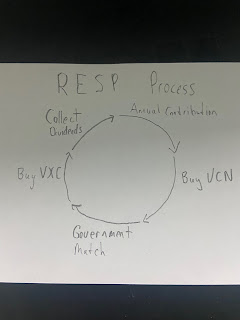
In May 2016, I posted about my ETF experiment involving buying VCN (Vanguard FTSE Canada All Cap Index ETF) and VXC (Vanguard FTSE Global All Cap ex Canada Index ETF) for my son's Registered Education Savings Program ("RESP"). Although this was a clear departure from my normal dividend growth investing strategy, the main reason that I pursued the strategy was simplicity. Having added my daughter to the RESP after she was born in July 2017, the two stock portfolio continues to be straight-forward, as shown in the below diagram. 

On a yearly basis, I spend about fifteen minutes on the strategy. The first five minutes relates to re-learning what is a needlessly complicated bill payment I have to use to make the annual contribution through Scotia itrade. A day or two later, after the contribution "magically" appears in the RESP account (sadly, I'm not making that up), I spend another five minutes calculating how much VCN to buy in order to keep the position sizes relatively equal, accounting for future government matches (both federal and to a lesser extent provincial) and upcoming dividends that will be added to the account. The last five minutes are split between buying VCN, and then waiting to see that both government matches hit the account before buying VXC.

Some of the advantages of this two stock RESP include:

- Very simple: Compared to the amount of time I spend on my normal portfolio, 15 minutes a year is awesome!
- Good country diversification: With half the portfolio allocated the Canada, VXC provides me exposure to the U.S., Japan, China, France, Switzerland, Germany, etc. at a very reasonable 0.27% management expense ratio. 
- Minimal cost: Beside VXC's 0.27% management expense ratio, VCN has a management expense ratio of only 6 basis points, and the two buys a year cost me a total of $20 in commissions. 
- Can do it all online: It's only been in the last three years that Scotia itrade hasn't required I send in a physical cheque to fund the annual contribution. 

On the flip side, there are disadvantages to the two stock RESP as well:

- Owning companies you'd rather not: With market capitalization being a dominant factor, there are a handful of companies in VXC I'd rather not own (i.e. Tesla, Facebook, etc.).
- VXC's holdings are not reflective of global market capitalization: VXC is heavily tilted toward the U.S. (60.5% of the ETF's holdings), and ignores some large international companies that are publicly traded (i.e. Saudi Aramco). 
- Scotia itrade's shortcomings: Charging $10 for buying an ETF, seeing your annual contribution disappear for a couple days, waiting an extra day or more to pay out dividends...all the frustrating parts of being a client of itrade continue to impact this RESP strategy.


The longer the two stock RESP experiment runs, the more I continue to love the simplicity of the strategy. I fully plan to stick to the strategy until my daughter turns 16, at which time the federal and provincial governments will no longer partly match the contribution. The only change I envision is potentially moving away from Scotia itrade given the shortcomings outlined above. 

Sunday, February 6, 2022

Water Your Flowers, Not Your Weeds

 "Selling your winners and holding your losers is like cutting the flowers and watering the weeds."
- Peter Lynch

An ongoing theme of my purchases in recent months is adding more to my positions in companies whose shares have increased in value ("winners"). Acknowledging this reality led me to explore the reasons behind this choice. Below are some of the key reasons why I have chosen to follow Peter Lynch's advice.

Accelerate the Compounding Process
Letting the power of compounding work for you by not selling winners early can lead to huge gains. My small October 2013 purchase of Microsoft grew to one of the largest positions in my portfolio. Before adding to this position in December 2021, I simply let the compounding process happen, but didn't accelerate it by adding additional shares. The choice to add to one of my biggest winners seems obvious in hindsight, but felt challenging over eight years given most of the metrics I track never led me to believe Microsoft's stock price would continue to rise.

Momentum is a Strong Force
Newton's first law indicates that "an object in motion stays in motion with the same speed and in the same direction unless acted upon by an unbalanced force". Extrapolating to a company's shares would seem to imply that stock prices will continue to go up unless there's a good reason they should stop or reverse course. Historically, I haven't put much faith in momentum when it comes to the stock market, and mentally have a very hard time "averaging up" my purchases. However, having seen the negative impact of averaging down on a couple of holdings (including Nortel around 20 years ago), I decided to make momentum my friend instead of fighting against it.

Lower Fear of Missing Out
After going through a phase of selling companies after I thought they became over-valued ("cutting the flowers"), that included exiting Home Depot prior to it tripling in price, managing my fear of missing out became more of a priority to tackle. Although I don't know who said it first, the idea that a company's stock price can always climb higher than you think is reasonable is something I've been trying to park at the front of my mind. Instead of trying to profit off of short-term stock price movements upward, being a long-term investor, I'm more interesting in sticking around for years when stock movement becomes indicative of business success.

Be Comfortable with Larger Positions
For years, I have tried to limit position sizes to a maximum of 5% of my portfolio. I have no idea why I used 5%, nor do I remember where the thinking came from. As I have tried to decrease my holdings over the past couple years, I started to question the 5% maximum, and now realize it's less realistic given only 35 holdings. Going forward, I'm scrapping 5%, and am comfortable if my large positions best represent my conviction and confidence in certain holdings. 


Clearly, the concept of adding to winners, and not averaging down on losers has been difficult for me. That said, I consider the implementation of the philosophy to be a journey, that will likely lead to a better destination as I follow this new path.

Sunday, January 16, 2022

14 Monthly Paying Canadian Dividend Growers for 2022

The 15th and last day of the month are special to me as I receive dividends from some companies in my portfolio that pay monthly. On the 15th, I receive dividends from Granite REIT, Canadian Apartment REIT, CT REIT and Realty Income. On the last day of the month, A&W Revenue Royalties Income Fund pays me my monthly distribution. If you get pleasure from seeing regular dividends coming into your portfolio each month, and you especially enjoy seeing them grow over time, the following table might be of interest to you. 

Using the Canadian Dividend All-Star list from December 31, 2021, I determined the monthly dividend growers for 2022. To be included, companies had to pay a monthly dividend, increase their distribution at least once in the last 12 months, and have a minimum 5-year history of annually increasing their payouts. From the 93 companies appearing on the initial Canadian Dividend All-Star list, there were only 15 who paid dividends monthly (the rest are quarterly payers). Sadly, I had to remove Chartwell Retirement Residences who had not raised their distributions in almost two years <- probably a good thing given the pandemic they have been navigating. The resulting 14 companies included nine real estate investment trusts (REITs). As the payout ratios and valuations of REITs are usually calculated based on funds from operations (FFO) or adjusted funds from operations (AFFO), looking at the EPS payout is not particularly relevant for these companies. For your browsing pleasure, here are the 14 monthly dividend payers heading into 2022:

CompanyDividend Growth Streak1-Yr Stock Price ReturnDiv Yield % (CAD)

[USD Ex = 1.2641]
1-yr DGR
'21
3-yr DGR
'19-'21
5-yr DGR
'17-'21
TTM EPS Payout Ratio %
Granite REIT1135.30%2.94%3.30%3.30%4.40%23%
Allied Properties REIT1016.20%3.87%3.10%2.80%2.50%59%
Canadian Apartment REIT1019.90%2.42%2.10%2.40%2.60%20%
Canadian Net REIT1020.00%4.25%17.40%14.20%13.30%35%
Firm Capital Property Trust REIT1025.20%6.55%1.90%3.50%3.80%26%
First National Financial Corp100.20%5.65%14.80%6.80%6.60%64%
InterRent REIT1026.40%1.98%5.00%6.30%7.10%15%
CT REIT910.50%4.85%3.80%4.10%3.90%169%
Parkland Corporation9-13.90%3.55%1.70%1.70%1.80%135%
Savaria Corporation932.50%2.61%4.40%9.10%17.80%105%
Global Water Resources Inc.813.80%1.72%1.00%1.00%2.50%225%
Badger Infrastructure Solutions Ltd6-16.40%1.98%5.00%6.40%10.10%n/a
Killam Apartment REIT537.90%2.97%1.70%2.60%2.80%29%
Summit Industrial Income REIT572.20%2.40%3.00%2.50%2.00%9%
Averages:8.7119.99%3.41%4.86%4.77%5.79%70.35%

As with any other screen, the above list is simply a starting point for further research. Clearly, a deeper dive is required based on the average EPS payout ratio over 70%. That said, the above list had an average return of 20% in 2021, including a 3.4% dividend payout and appears to be growing distributions by about 5% yearly, all very impressive figures.

As always, if you know of any other Canadian monthly dividend payers with a history of boosting their payouts, please reach out to me so that I can correct the above list.